Examples of industrial robots: real cases of automation in companies
Industrial robotics is no longer a thing of the future. It’s happening here and now, transforming how companies manufacture, package and handle their products every day. That’s why, in this article, we show you real industrial robot examples of how they are helping all kinds of companies to successfully automate processes.
At SEMAPRO we have been helping companies from different sectors to automate their processes with real and effective solutions.
And when we say ” realsolutions “, we mean it. In this article, you will find concrete examples of industrial robots at work.
Realcases, real projects, real results.
All grouped by application type, so you can clearly see how they can help your productivity, safety and accuracy. And the best part: no matter the size of your business.
What is an industrial robot?
An industrial robot is not just a mechanical arm that moves around. In reality, it is a programmable, precise and rugged tool designed to handle repetitive, dangerous or tasks that require near-surgical accuracy in production environments.
Unlike cobots – those collaborative robots that share space with people- industrial robots tend to work inside closed cells, at full speed and with great force. This makes them the ideal choice for applications such as welding, palletising, assembly or handling heavy loads.
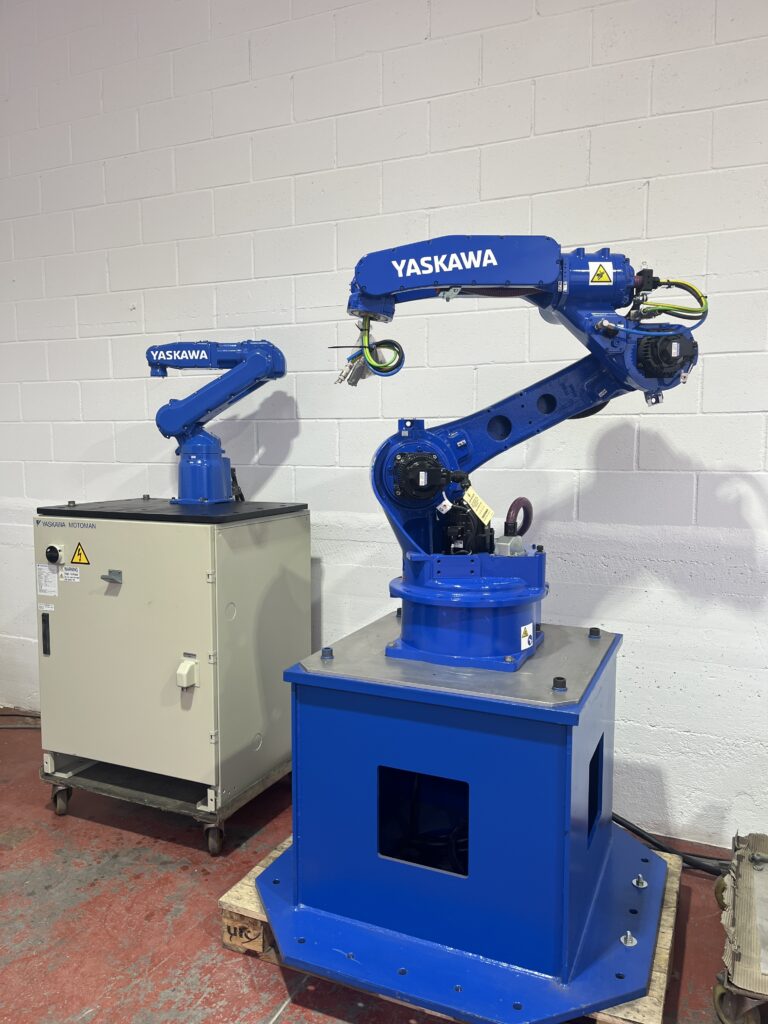
And they don’t work alone: they integrate with sensors, vision systems, special tools and even positioners, adapting like a glove to every task.
In conclusion, the key is not only to know how to programme them well, but also to know exactly what you need.
Examples of industrial robots by function
Automated Welding
Welding by hand requires skill, practice… and a lot of pulse. But when it comes to high volumes or maintaining consistent quality for hours on end, industrial robots are unstoppable.
At SEMAPRO we have integrated numerous automated welding systems with robots from leading brands such as Fanuc, Yaskawa, ABB or Motoman, adapted to different sectors: automotive, metallurgy, heavy machinery …
Yes, each sector has its own requirements, but everyone is looking for the same thing: speed, precision and safety.
Real-life examples of robotic welding
Fanuc Robot welding MIG-MAG
This video shows a Fanuc robot applying MIG-MAG welding to metal parts. The result: consistent weld seams and reliable automation without interruptions.
Ideal for increasing productivity and reducing the margin for human error.
Yaskawa HP6 Robot welding aluminium
Here we show a Yaskawa HP6 with RM2 positioner and Fronius machine, welding aluminium with continuous wire.
A very useful solution for light parts and environments where repeatability and quality go hand in hand.
Palletising and logistics
At first glance, putting boxes on a pallet doesn’t seem complicated. But when you do it thousands of times a day, things change.
Industrial palletising robots organise loads continuously, relentlessly and with millimetre precision.
It is no longer just about efficiency, but also about reducing occupational risks, minimising downtime and optimising production output.
Real-life example: Fanuc Robot in action
This video shows a Fanuc robot performing palletising simulations. Every movement is calculated: speed, angle, position…
This type of automation improves the logistics flow and frees staff from repetitive physical tasks.
Positioners and precision systems
When the job requires maximum precision, or when the workpieces are too heavy to move easily, more than just the robot comes into play. This is where positioners, rotary tables and rotation systems become indispensable.
At SEMAPRO we have developed solutions that combine industrial robots with indexing tables and customised turning systems, achieving advanced automation with total repeatability.
Ejemplos real
Yaskawa Robot with H-type table in sensing processes
This system is capable of handling heavy parts with high precision, combining a Yaskawa robot with a rotary H-table that positions each component exactly where it needs to be.
In the following videos you can see how the same installation can execute different work sequences. This allows sequential tasks to be automated much more efficiently, while maintaining consistent quality.
Thanks to this flexibility, the system provides repeatability and reliability even in complex processes.
Robots on rails (tracks)
When a fixed cell is not enough, and you need the robot to cover several workstations or large areas, it is best to put it on rails. Robots on tracks move along production lines to perform tasks at different stations.
This not only expands the working area, but also reduces the need for multiple stationary robots and optimises resources.
Examples of industrial robots in motion
Yaskawa robot on track with positioners
This automation system combines a Yaskawa robot moving on rails to handle large parts with pinpoint accuracy.
It is a clear example of how industrial robots can cover several workstations on a single line, maintaining efficiency, repeatability and safety in demanding environments.
Mobile robot system on track
This example shows how an industrial robot moves on rails to perform tasks at different points of a production line.
A perfect solution for long lines or modular processes.
Machine vision systems
Robots with machine vision are the next level. They not only execute programmed tasks, they see, interpret and adapt. They can recognise parts, correct deviations and work with multiple formats without the need for manual reprogramming.
At SEMAPRO we have implemented this technology for applications such as quality inspection, presence verification or intelligent picking.
Real example
Fanuc robot with artificial vision
In this case, the robot uses a vision system to detect parts and adjust its position in real time.
In other words, it uses intelligent automation that adapts to the reality of the environment, not only to the plan.
Benefits of implementing industrial robots
Automation is not just a fad: it is a real tool for companies to become more competitive in an increasingly demanding market.
So, if you have not yet seen the benefits with the examples of industrial robots in the previous section , here are some more examples:
- Increased productivity: They work without interruptions, with constant speed and without errors due to fatigue.
- Cost reduction: Less waste, less rework, more efficiency in every cycle.
- Quality improvement: They perform tasks with millimetre precision, always the same, always right.
- Worksafety: They take care of dangerous or physically demanding tasks, taking care of your staff.
- Flexibility: They can be adapted to different processes, products or volumes as you need.
As you can see, implementing industrial robots has clear advantages: more productivity, less human error, more safety for the equipment and better operational efficiency.
In short: more production, better quality and less risk.
Tell us what you do.
We'll tell you how to improve it.
Do you have a process that could be faster, safer or more cost-effective with automation?
Leave us your phone number and tell us about your case. We will give you real ideas, without obligation and adapted to your company.
Frequently asked questions about industrial robots and their application
What tasks can industrial robots perform?
From welding and screwing to palletising and packaging. They are used in sectors such as automotive, electronics, logistics, food, among others.
Are industrial robots only for large companies?
No. In fact, every day many small and medium-sized companies are incorporating robots into their processes. The reason? Automating no longer involves a huge investment and does not require a building with many metres of floor space.
Affordable, compact and adaptable solutions are available to automate repetitive tasks, improve quality and free operators from drudgery and drudgery. All without complicating your life.
Collaborative robots, for example, can work side by side with people without the need for physical barriers. And refurbished robots offer excellent value for money without compromising on reliability.
In short: automation is within the reach of any company that wants to take a step forward, optimise processes and gain in efficiency. You don’t need to be a multinational. You need to have vision.
What is the difference between an industrial robot and a collaborative robot (cobot)?
Industrial robots are often isolated for safety and perform repetitive tasks at high speed. Cobots work alongside people and are ideal for more flexible or delicate processes.
Here you can find out more about cobots.
How long does it take to amortise an industrial robot?
It depends on the sector and the type of robot, but in many cases the return on investment comes in 1 to 3 years, thanks to savings in time, errors and costs.
Where can I see real examples of industrial robots in use?
There are several examples in this article , but you can also consult real company cases compiled by the International Federation of Robotics (IFR).
How can we help you?
At SEMAPRO we have been doing what we love the most for more than 20 years: helping companies to grow thanks to industrial automation and robotics.
From our workshop, we work with sectors such as automotive, food, logistics, metal and many more. And we do it from start to finish:
-
Sale of reconditioned industrial robots (economical and in perfect condition).
-
Design and installation of customised roboticcells.
-
Programming, integration and implementation of real solutions.
-
Maintenance and repair so that nothing stands still.
-
Practical training to help your team get the most out of technology.
Our approach is clear: technology is not just another expense, but a real and tangibleadvantage for your company. We accompany you from the first consultation until your robot starts working (and beyond, if you need us).
Did you like it?
This is just the beginning. If you are interested in more case studies, applied technologies and practical solutions for industrial automation, subscribe to our newsletter.
We will notify you when we publish new articles with concrete examples, technical tips and trends in industrial robotics.