Preventive maintenance of industrial robots: what it involves and how often it should be carried out
Preventive maintenance of industrial robots is one of the most cost-effective decisions in any production environment. It involves preventing breakdowns and maintaining production stability, extending the robot’s service life and reducing unforeseen costs.
In this article, we explain what preventive maintenance actually involves, how often it should be carried out, and what signs indicate that it’s time to take action.
What is preventive maintenance for industrial robots?
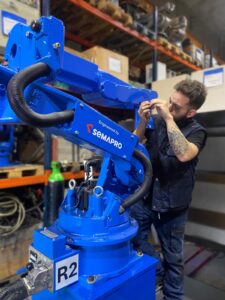
Preventive maintenance involves a series of scheduled inspections carried out before faults occur. Unlike corrective maintenance, which comes into play once a problem has already arisen, preventive maintenance aims to anticipate such issues.
In industrial robotics, this is particularly important because many faults do not occur suddenly, but develop over time: play in parts, component wear, intermittent electrical faults, etc.
What does preventive maintenance for an industrial robot involve?
Although this may vary depending on the brand (ABB, Fanuc, KUKA, Yaskawa, etc.), there is a common framework that should cover any intervention:
🔧 Mechanical inspection
- Checking for play in shafts
- Condition of gearboxes
- Brake inspection
- Checking the arm’s internal wiring
⚡Electrical inspection
- Status of connections and terminals
- Inspection of electronic cards
- Diagnosis of historical alarms
🛠️ Lubrication and adjustments
- Lubrication of the shafts in accordance with the manufacturer’s specifications
- Replacement of greases or oils
- Fine-tuning, if necessary
💻Review of the control system
- Full system backup
- Parameter verification
- Checking software versions and status
🔍 Safety inspection
- Emergency stops
- Active safety systems
- Status of peripherals (torch, gripper, etc.)
How often does maintenance need to be carried out?
There is no single answer, but in standard industrial settings:
- ✔️ Every 6–12 months → full preventive maintenance
- ✔️ Every 2,000–4,000 hours of operation → recommended service
- ✔️ Demanding applications (welding, continuous load) → shorter intervals
The important thing is to consider how the robot will actually be used.
What happens if you don’t carry out preventive maintenance?
In many companies, maintenance is put off until a fault occurs. The problem is that when that happens, the cost is no longer just the repair.
Some common consequences:
- Unplanned production stoppages
- Loss of precision in processes (welding, handling, etc.)
- Major breakdowns that could have been avoided
- Higher costs for emergency repairs
A minor problem that isn’t spotted in time can end up requiring a much more complex procedure.
Signs that your robot needs servicing
There are clear signs that should not be overlooked:
- Occurrence of abnormal noises or vibrations
- Loss of repeatability
- Recurring alarms
- Temperature rise in shafts
- Changes in process quality (irregular welding, positioning errors)
If any of these signs appear, it is advisable to have the equipment checked as soon as possible.
Why choose SEMAPRO for maintenance?
At SEMAPRO, we work directly on operational equipment, not just on manuals. This enables us to identify wear and tear, necessary adjustments or potential faults before they affect production.
Quick and technical interventions
When a problem arises, the important thing is not just to solve it, but to understand where it comes from. Our approach is to intervene with good judgement, avoiding temporary fixes that end up causing further downtime.
⚙️ Experience and Expertise with multiple brands
We regularly work with robots from brands such as Yaskawa, Fanuc, ABB and KUKA, which allows us to adapt to different environments without being tied to a single manufacturer.
🛠️ Maintenance based on actual usage
Not all robots operate in the same way. We tailor maintenance schedules to suit the workload, the application (welding, handling, etc.) and the condition of the equipment.
🔍 Complete overview of the robot’s status
Rather than just a one-off check, we analyse the whole picture: mechanics, controls, processes and the environment. This enables us to anticipate problems that are not always obvious.
📉 Reduction in downtime and unforeseen costs
The aim is clear: to avoid urgent interventions and maintain stable production. In practice, this translates into fewer incidents and greater operational continuity.
Conclusion
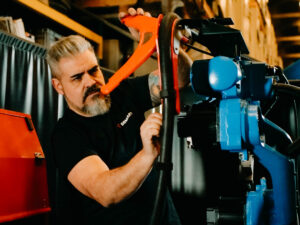
Preventive maintenance isn’t an expense; it’s a way of ensuring that production doesn’t come to a standstill.
Using it regularly allows you to work more reliably, avoid unexpected issues and extend the robot’s service life. In environments where every downtime counts, being proactive makes all the difference.
👉 If you’d like to check the condition of your equipment or set up a maintenance plan tailored to your production needs, you can view our technical support service here